

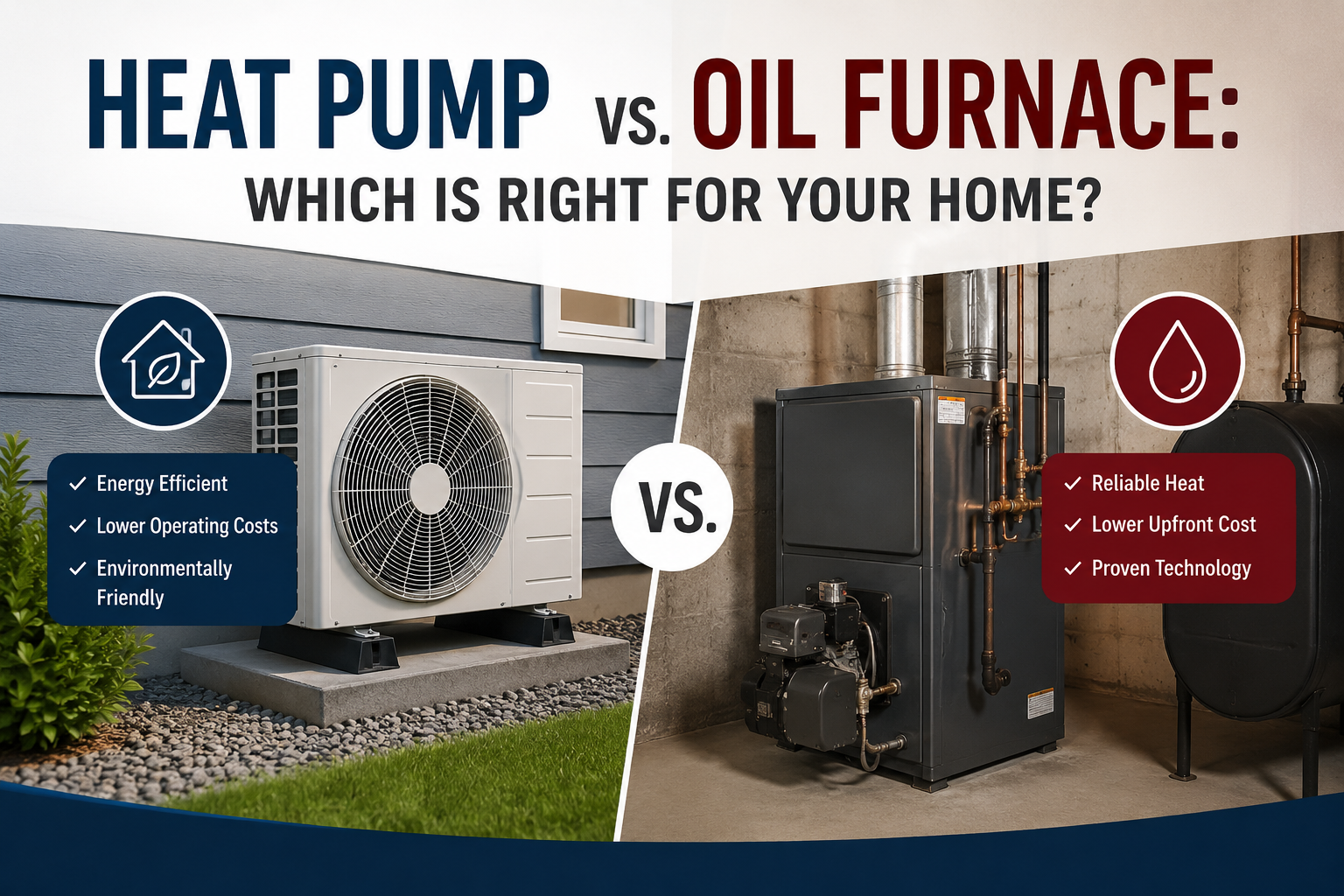
We’ve been answering heating calls in the Farmington Valley since 1947, and a good chunk of those calls come from the same kind of house: a 150- or 200-year-old Connecticut farmhouse with plaster walls, no wall insulation, single-pane storm windows, and an oil system that’s been patched together for two generations. When homeowners in these houses ask us whether a heat pump makes sense, the honest answer is usually yes, but not the way most articles frame it. Here is a quick guide to help you make the right choice:
The Efficiency Case Is Real
Let’s start with the numbers. Heat pumps are 2 to 4 times more energy-efficient than oil furnaces, even in cold climates, and they provide both heating and cooling from a single system. A modern cold-climate heat pump moves 2 to 3 units of heat for every unit of electricity it uses. An oil furnace, by contrast, is simply burning fuel oil; it runs at a coefficient of performance around 0.84, compared to a heat pump’s typical 3.0.
On operating cost, the math has shifted heavily in the heat pump’s favor over the past few years. At a COP of 2.5, which is a conservative seasonal average for a cold-climate heat pump in the Northeast, electricity delivers heat at roughly $16.41 per million BTU, versus about $39.20 per million BTU for oil at $3.50 a gallon. This is a 2.4x cost difference in the heat pump’s favor. Heat pumps typically run 20-40% cheaper than oil in New England, at roughly $25.80-$34.00 per million BTU compared to oil’s $29.30.
But the Cold Doesn’t Care How Old Your House Is
Here’s where the marketing glosses over something we see firsthand: a heat pump doesn’t know or care that your farmhouse was built before insulation was standard practice. Today’s cold-climate heat pumps maintain a COP of 2.0-2.8 at 20°F, though backup heating is recommended for extreme cold snaps below 0°F. That’s a legitimate concern for a lot of the farmhouses we service. Old plaster-and-lath walls with zero cavity insulation lose heat fast, and a heat pump working overtime against constant drafts is going to run harder and cost more than the same unit in a tight, modern build.
That’s not a heat pump problem specifically; it’s a building envelope problem. HVAC contractors have long debated whether a drafty, poorly insulated house makes a heat pump a bad choice, and the honest answer heard again and again in the trade is that a leaky house drives up costs for oil furnaces just as much as it does for heat pumps. The fuel source doesn’t fix a drafty envelope; insulation does.
What We’ve Learned Actually Works
For most of the century-old farmhouses we work on, the fix isn’t just swapping fuel sources; it’s sizing the system to the actual house instead of a generic spec sheet. A heat pump sized for a modern, tightly sealed home will come short in an uninsulated farmhouse, and one oversized to compensate will short-cycle and wear out faster. We spend real time walking the house, room by room, before recommending equipment.
There’s also a practical installation advantage specific to old farmhouses. Ductless mini-split heat pumps are especially well-suited to historic homes because they require only small holes for refrigerant lines rather than the extensive ductwork a full forced-air conversion would demand. This matters when you’re trying to avoid tearing into original plaster and woodwork. For a lot of our farmhouse customers, that means ductless heat pumps handle the main living spaces well, while their existing oil furnace or boiler stays in place, serviced and ready, for the coldest stretches of the year, rather than forcing an all-or-nothing decision on day one.
Weigh the Upfront Cost
None of this is free, and we tell customers that upfront. A whole-home heat pump installation averages around $15,393 before incentives, compared to $6,425-$9,175 for a straight oil furnace replacement. That gap narrows with Connecticut’s Energize CT incentives for qualifying heat pump installs, and it narrows further every winter oil prices spike, since a typical Northeast household spends $2,864-$3,580 per year on oil fuel alone.
Bottom Line
If your farmhouse still has its original oil boiler and drafty windows, don’t expect a heat pump alone to solve everything on day one. The house needs some envelope work too. What we’ve seen actually deliver lower bills and fewer emergency calls is a system sized correctly for your specific house, not a generic spec sheet, whether that’s a full heat pump replacement, a ductless mini-split for the rooms that need it most, or simply keeping your oil furnace properly maintained while you plan your next step. It’s worth having someone walk your specific house before deciding, since a farmhouse in Burlington with a finished attic behaves differently than one with an open, uninsulated one two towns over.
Not sure what your house actually needs? Call F.J. Chard & Son at (860) 675-8086 and we’ll walk your home and give you an honest answer. .